Originally posted on my linkedin https://www.linkedin.com/pulse/figmas-billion-dollar-positioning-problem-aditya-mishra-bqk8c/
March 12, 2026
Figma has been one of my most utilized products ever. Couldn’t have imagined building so many products without it being in the centre. However, my biggest bone with it was that product thinking never lived inside Figma. All elements of product sense such as strategy, goals, requirements, research, tradeoffs, customer context, and engineering constraints all existed upstream of the design file.
Figma was still important because it gave us a place to translate that material into something concrete. Screens, flows, prototypes, and design systems could be reviewed via Figma in a shared visual language. That position carried a lot of power. For my teams, the first durable artifact of a product idea used to take shape inside Figma.
Even when the thinking happened elsewhere, the design file was still close to the moment when much of our ambiguity turned into structure. This made Figma feel central to our creation process.
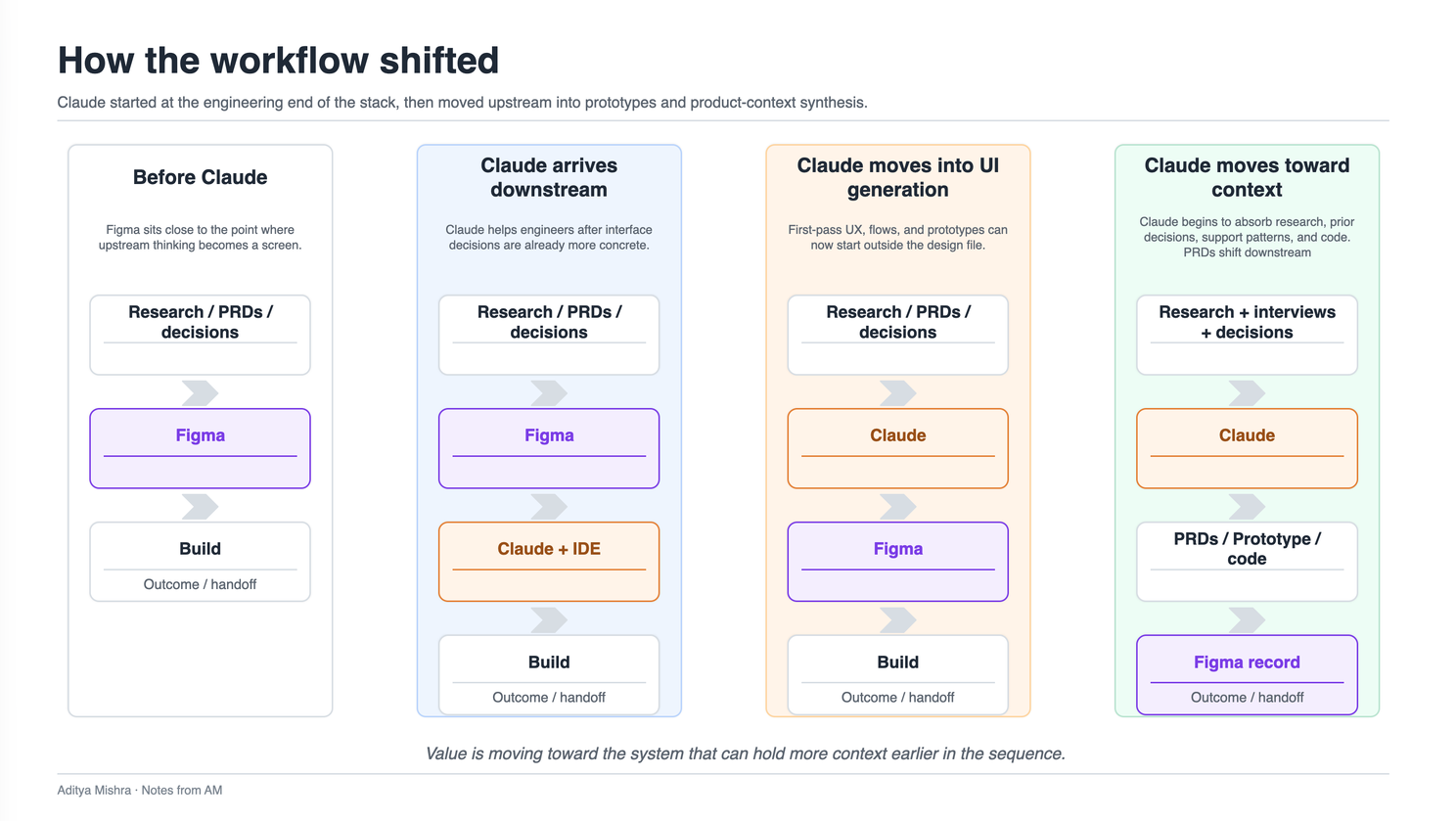
The workflow has changed a lot for us now. Three fundamental shifts happened in quick succession and in hindsight, shape our current challenge with Figma.
In the first shift, Claude entered our teams through the engineering route. It was useful in the build layer because it could read code, make changes, explain implementation choices, and speed up iteration inside the repository. That already shifted some leverage away from the design file, but only at the back end of the workflow.
The second shift was more important. Claude became useful for generating interfaces and working prototypes. Once teams could move from product inputs to a functioning draft in code, the first artifact no longer had to begin in a design canvas. Figma saw this clearly enough to launch Make as a prompt-to-app workflow inside Figma, and that product initially ran on Claude Sonnet.
The third shift is where the strategic pressure really builds. Claude is getting closer to the product context that shapes the first draft of our product thinking. Claude can work across a brief, research notes, prior decisions, design references, slack threads and the codebase and it influences structure earlier. A big chunk of product value comes from context synthesis. The first pass reflects more of the actual problem because more of the surrounding context is available when the artifact is created.
This is why Make can feel thinner than the broader Claude workflow. Prompt-driven generation inside the design tool is useful, but its output is only as strong as the context available at that moment. When the richer context still lives elsewhere, we spend more time steering the tool back toward the real problem. A system that already has access to the surrounding product material starts from a stronger position.
This is the backdrop for Figma’s recent Claude Code integration. In February 2026, Figma introduced a way to capture running interfaces from Claude Code and turn them into editable Figma frames. The move is smart because it reflects the workflow as it increasingly exists. A team may begin with code-first exploration, then bring that work into Figma when it needs comparison, annotation, divergence, and shared review. Figma’s own framing is close to this: code helps teams converge quickly, while the canvas helps them explore collectively once something concrete exists.
Figma is trying to stay attached to the part of the workflow where value is moving by making its design context available earlier.
These are thoughtful product decisions. They improve Figma’s position in a workflow where creation is becoming more fluid across code, context, and canvas. But they also reveal the underlying problem.
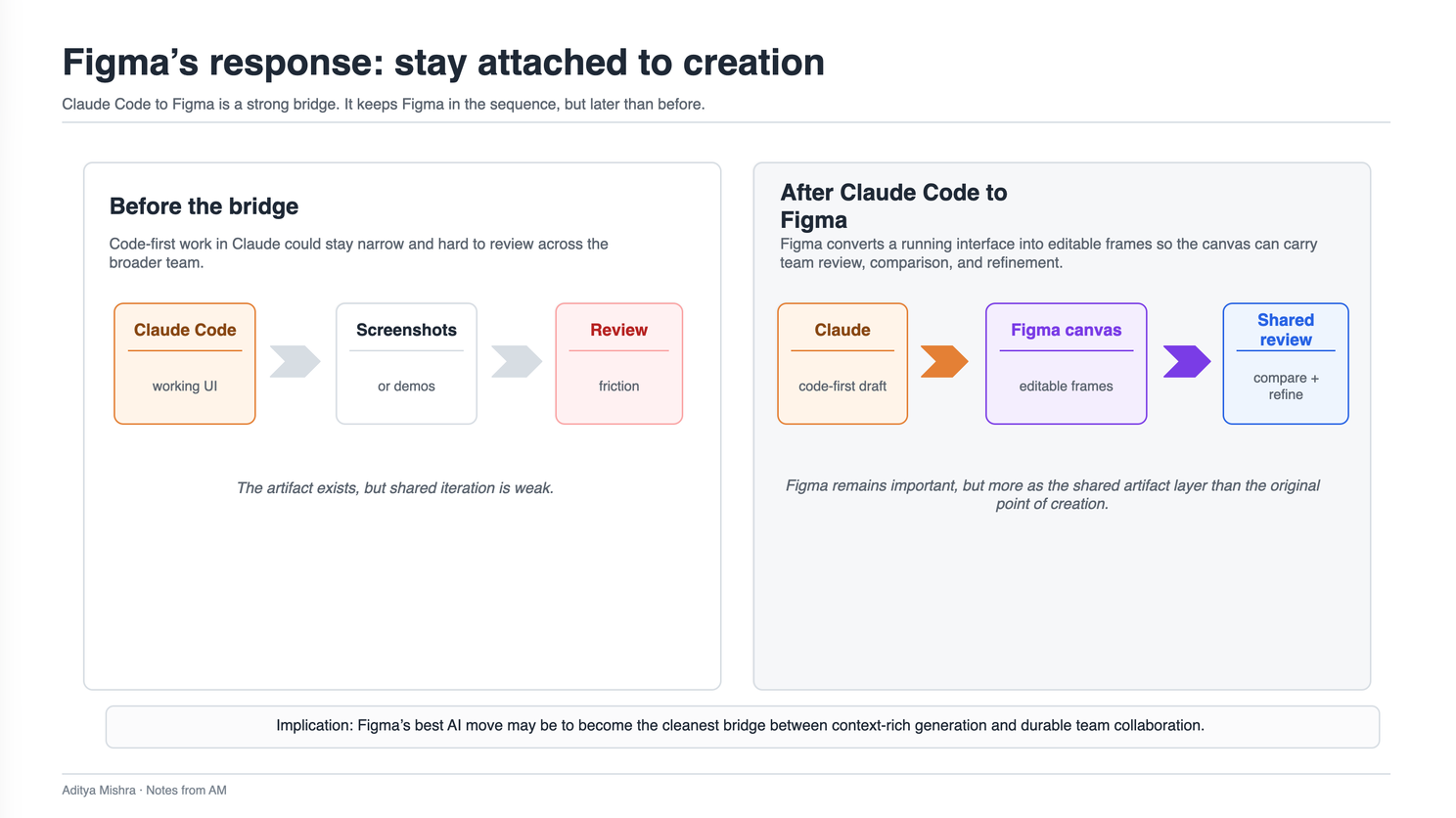
Figma is working to remain close to creation at a moment when more of the shaping work may happen before the design file is opened. If Claude can move from product context to prototype to build with increasing continuity, then Figma receives the work later in the sequence. The canvas still matters as a place to inspect the system, align across functions, preserve component logic, and maintain a shared artifact over time. That remains valuable but the role becomes more downstream.
This seems to be the pressure on Figma. The design file is still useful once the work becomes visible. But the center of gravity may now be somewhere earlier even if the company still owns an important artifact layer. The open question is how much strategic weight remains with that layer if the highest leverage step in software creation moves toward systems that can gather context earlier and carry it further.